
Our Commitments to the Community
At the Australian Autism Knowledge Hub, we believe that research and knowledge should make a meaningful difference in the lives of Autistic people, families and communities.
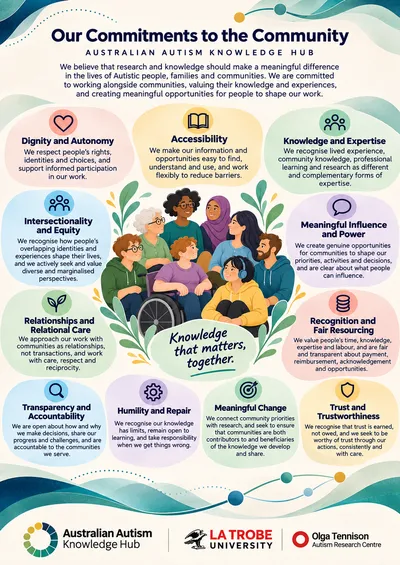
The following commitments describe what communities should be able to expect from us:
Dignity and Autonomy
We will ground our work in human rights and respect people’s inherent dignity, identities and choices. We will presume competence and recognise people's right to make decisions about their own lives.
We will support informed choice about how, when and whether people take part in our work, including whether they share personal experiences. We will respect their right to change their minds.
Accessibility
We will work to make our information and resources easy to find, understand and use, and create accessible opportunities for people to take part in our work.
We will offer flexible ways to access information and participate, adapting our approaches in response to people's needs, preferences and feedback.
We will consider accessibility from the outset, rather than treating it as an afterthought. We will take responsibility for identifying and reducing barriers, rather than expecting people to change themselves to fit how we work.
Knowledge and Expertise
We will recognise lived experience, community knowledge, professional learning and research as different forms of expertise that contribute to building and understanding evidence. We will value how these different forms of expertise can inform, complement and challenge one another.
We will respect people as authorities on their own experiences, without needing a professional to confirm what they know. We will also recognise that no one person can speak for an entire community, and that differences in experiences and perspectives are valuable sources of knowledge.
Intersectionality and Equity
We will recognise how people’s overlapping identities, experiences and circumstances, alongside systems of power, privilege and discrimination, shape people’s lives, opportunities and priorities.
We will actively seek and value minority and marginalised perspectives, including those that challenge dominant views. We will not assume that the most common or powerful perspectives represent the needs and priorities of everyone.
We will work with communities to understand their different priorities, ways of knowing and ways of working. We will question our own assumptions and adapt our approaches so that these perspectives can meaningfully shape our work.
Meaningful Influence and Power
We will create meaningful opportunities for communities to shape our priorities, activities and decisions. We will involve people early enough for their contributions to make a difference.
We recognise that inviting people to participate does not, by itself, mean sharing power. We will be clear about what people can influence, who makes the final decisions, and what limits exist.
Relationships and Relational Care
We will treat our work with communities as relationships, not transactions. We will take time to listen, understand and respond, recognising that meaningful relationships require care and respect.
We will respect people’s boundaries, different ways of communicating and engaging, and their right to disagree with us. We will value people beyond the contributions they make to our work.
Recognition and Fair Resourcing
We will value and recognise people’s time, knowledge, expertise and labour. We will take their contributions seriously, not simply collect them.
We will be fair and transparent about payment, expenses and recognition, and opportunities arising from people’s involvement.
Transparency and Accountability
We will be open about how and why we make decisions, who holds responsibility for them, and what limits or constraints shape our work.
We will explain how community contributions have informed our decisions, including when we cannot act on advice and why. We will share our progress, challenges and outcomes so that communities can see what difference their contributions have made.
We will be accountable to the communities we serve, welcoming feedback and challenge, and taking responsibility for following through on our commitments.
Humility and Repair
We recognise that our knowledge and expertise are incomplete, and that people and communities may hold knowledge and perspectives that we do not yet understand.
We will approach our work with openness and curiosity, remaining willing to question our assumptions, learn from others and change how we work.
We recognise that we will sometimes make mistakes, and that even well-intended actions can have unexpected impacts. When this happens, we will listen, acknowledge those impacts, take responsibility for our response, and work to put things right where we can.
Meaningful Change
We will connect community priorities with research, and research knowledge with the people who can use it.
We will work towards research and knowledge that are relevant, practical and useful, and that contribute to meaningful improvements in the lives of Autistic people, families and communities.
We will seek to ensure that communities are both contributors to and beneficiaries of the knowledge we develop and share. We will seek feedback on whether our work is making a difference, and use what we learn to improve what we do.
Trust and Trustworthiness
We recognise that trust is earned, not owed, and that people and communities may have good reasons to be cautious about trusting research institutions. Trust takes time to develop, can be damaged, and cannot be assumed.
We will seek to be worthy of trust through our actions, by putting these commitments into practice consistently and with care, including when doing so is difficult.
Developing our Community Charter
These are the Hub’s interim commitments, informed by the guiding principles developed with our Advisory Panel.
In 2027, we will work with the Panel and seek wider community input to co-design a full Community Charter.
The Charter will build on, challenge and refine these commitments, helping establish shared expectations about how the Hub works with communities and remains accountable to them.