
Participation with Purpose: How Communities Are Helping Shape the Australian Autism Knowledge Hub
The Australian Autism Knowledge Hub works with communities to shape research and activities. It values people’s experiences and perspectives. The Hub aims to make participation accessible, show how contributions influence decisions, and keep learning from Autistic people, families and communities.

Research is more likely to make a difference when it responds to the needs, priorities and experiences of the people it aims to benefit.
Working alongside communities can help make research more relevant, practical and useful. It can also help ensure that research findings reach the people who need them and support meaningful change.
At the Australian Autism Knowledge Hub, we want to do more than produce and share knowledge. We want that knowledge to help improve the lives of Autistic people, families and communities.
That’s why meaningful community participation is central to how we work.
What do we mean by participatory approaches?
Participatory approaches involve people with different forms of knowledge, experience and expertise to inform, shape and contribute to research, activities and decisions.
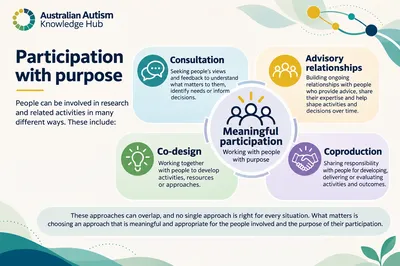
People can be involved in research and related activities in many different ways. These include:
- Consultation: Seeking people’s views and feedback to understand what matters to them, identify needs that might otherwise be overlooked, or inform decisions.
- Advisory relationships: Building ongoing relationships with people who provide advice, share their expertise, and help shape activities and decisions over time.
- Co-design: Working together with people to develop activities, resources or approaches.
- Coproduction: Sharing responsibility with people for developing, delivering or evaluating activities and outcomes.
These approaches can overlap, and no single approach is right for every situation. What matters is choosing an approach that is meaningful and appropriate for the people involved and the purpose of their participation.
They can also be combined, and one is not always better than another. The right approach depends on the activity.
What matters is not simply what we call an activity, but whether people have meaningful opportunities to contribute, whether their knowledge is valued, and whether their involvement makes a difference.
Being purposeful about participation
We don't want to undertake community engagement simply to say we’ve done it.
Instead, we begin by asking some important questions about how, when and why we work with communities:
- Whose knowledge and experiences do we need?
- Whose perspectives might be missing?
- Why are we asking these people to contribute?
- When should we involve them so their contributions can influence the work?
- How can we make participation accessible, safe and worthwhile?
- What can people influence, and how will we show them what happened to their contributions?
We also recognise that participation involves questions of power. Some types of knowledge and expertise are not always given the same recognition or influence as others.
Our responsibility is to create meaningful opportunities for people to contribute, be transparent about the decisions they can influence, and remain accountable for how we use their advice.
Our Community Advisory Panel
One way we're putting these commitments into practice is through the Hub’s Advisory Panel.
The Panel brings together people with diverse experiences, knowledge and connections to Autistic and autism communities. Members give ongoing advice about the Hub's priorities, activities and decisions.
The Panel is an advisory body. Final decisions remain with Hub leadership, but members can influence those decisions, question our approaches and challenge how we work.
We've designed the Panel to support different ways of taking part, including online meetings, written contributions, discussions outside meetings and individual conversations.
Members are paid for their time, and we work with them to identify the supports they need to participate.
Importantly, we don't expect the Panel to speak with one voice. Different perspectives, including disagreement and dissent, are valuable forms of advice.
Reaching beyond the Panel
No single group can represent the full diversity of Autistic and autism communities.
We also recognise that many people have historically had fewer opportunities to influence autism research, including non-speaking people, people with very high or complex support needs, and people who experience multiple forms of marginalisation.
We know that meaningful participation can be complex, and we don’t assume that we know what will work best for every person or community.
Rather than expecting everyone to participate in the same way, we're working to understand how we can adapt our approaches to different needs, preferences and circumstances.
This includes learning directly from people and communities about what makes participation accessible, culturally appropriate and meaningful for them.
For example, alongside our national research priorities survey, we’re speaking directly with communities whose perspectives may otherwise be missed.
We're also working with First Nations researchers at La Trobe University’s Gabra Biik Wurruwila Wutja Indigenous Research Centre to develop approaches to understanding the autism research priorities of Aboriginal and Torres Strait Islander people, families and communities.
We recognise that this is ongoing work. Meaningful inclusion requires us to keep listening, learning and changing our approaches in response to what communities tell us.
Showing how community input makes a difference
An essential part of meaningful participation is what we call “closing the feedback loop”. This means letting people know how their contributions have been considered and what difference they have made.
Not every suggestion can be adopted, and different community members may have competing priorities. But we believe people deserve a clear explanation of how their contributions have influenced our work, including when we decide not to follow their advice.
Continuing to learn and improve
We’re still developing our participatory approaches, and we know we won’t always get things right.
Meaningful participation takes time, care and a willingness to learn. We recognise that our approaches won’t work equally well for everyone, and that we may sometimes overlook needs or perspectives despite our best intentions.
Our commitment is to listen when people tell us something isn’t working, be open about our decisions and mistakes, and make changes where we can.
We want communities to see not only what we’ve achieved together, but also what we’re still learning and where we need to do better.
One of our next steps is to work with the Advisory Panel, and potentially wider communities, to co-design a Community Charter. This will help set shared expectations about how the Hub works with communities and remains accountable to them.
Ultimately, our goal isn’t to undertake community engagement for its own sake. It’s to make participation purposeful, accessible, influential and accountable so that the knowledge and experiences of Autistic people, families and communities help shape research that makes a genuine difference.