At a glance
Who may find this snapshot useful and why?
This snapshot may help Autistic people, families, and advocates explain how differences in showing emotions can be misunderstood in the justice system. It may also help lawyers, court staff, and people who serve on juries recognise how assumptions about remorse or showing regret can affect judgements about Autistic people. It may also encourage people working in the justice system to question these assumptions and consider how to make fairer decisions.
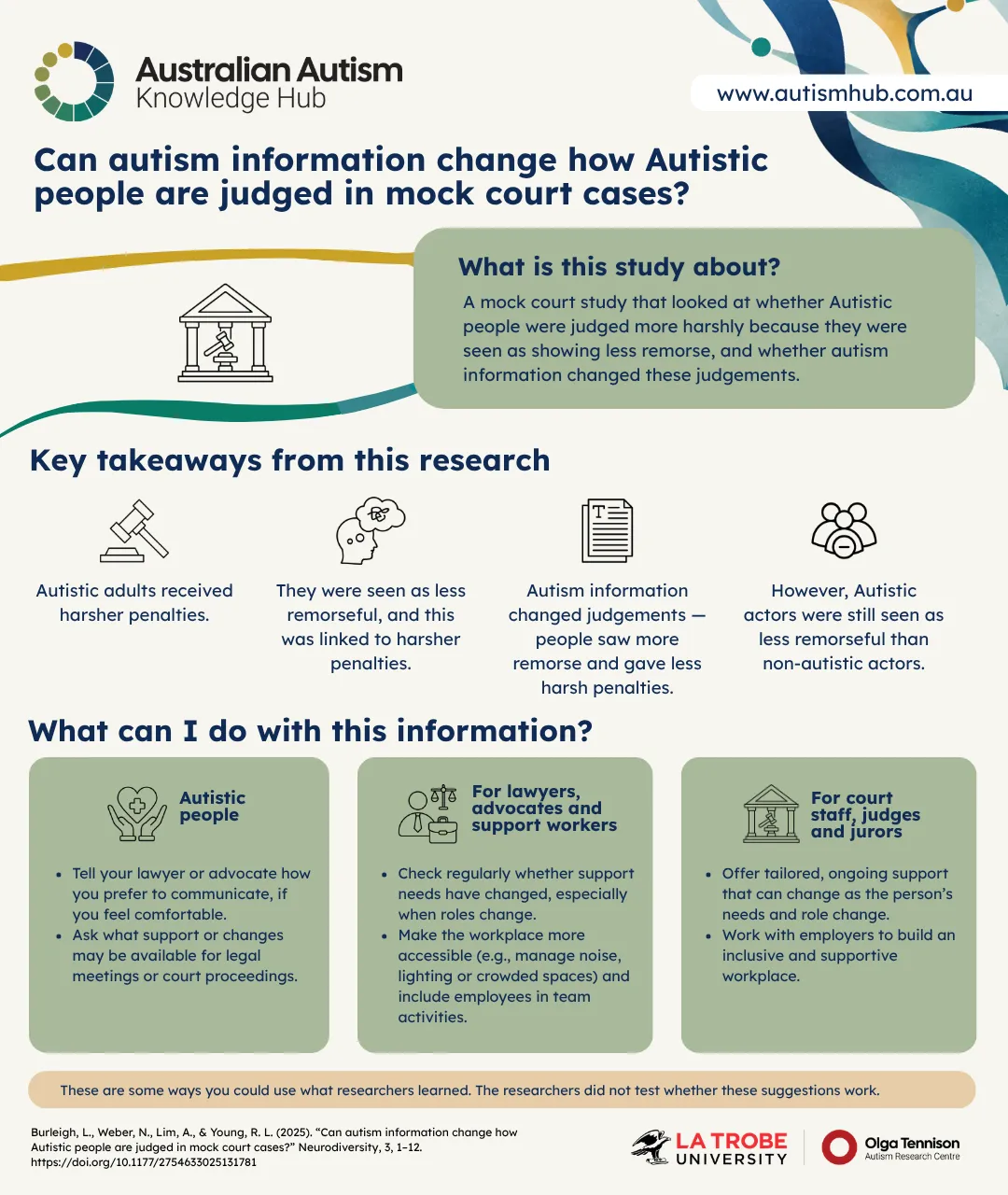
What is this study about?
Remorse can affect decisions about punishment in the justice system. Remorse means feeling sorry or regretful about something you have done and understanding your actions may have affected someone else. This study looked at whether Autistic people were judged more harshly because non-autistic people saw them showing less remorse. It also tested whether receiving information about autism changed these judgements.
Why did we choose to create a snapshot of this study?
Autistic people and those who support them may already know that differences in communication and showing emotions can be misunderstood by others. We felt this study was important to share because it explores how these misunderstandings may affect judgements about Autistic people in the justice system. It also looks at whether providing information about autism can change these judgements. This is important because misunderstandings can have serious consequences for Autistic people.
What are the key takeaways from this research?
Autistic adults received harsher proposed penalties
- In this study, 195 non-autistic adults watched videos of Autistic and non-autistic actors playing people accused of a crime.
- In the videos, the actors played people who had pleaded guilty to made-up crimes. Before autism information was given, the non-autistic adults watching rated penalties as harsher for Autistic actors.
Perceived remorse was linked with penalty harshness
- The non-autistic adults watching thought the Autistic actors seemed less sorry. When they thought an actor seemed less sorry, they tended to give a higher penalty rating.
- When non-autistic adults thought someone showed less remorse, they suggested harsher penalties. This suggests that differences in how Autistic people show emotions may affect how others judge them.
Autism information changed some judgements
- Non-autistic adults were given information about autism, including differences in eye contact, facial expressions, body movements, and showing emotions. After receiving this information, they rated the Autistic actors as showing more remorse.
- Non-autistic adults also suggested less harsh penalties for the Autistic actors.
- However, the Autistic actors were still rated as showing less remorse than the non-autistic actors.
What can I do with this information?
These are some ways you could use what the researchers learned. The researchers did not test whether these suggestions work. The study used made-up court situations and did not test whether these suggestions lead to fairer decisions in real legal cases.
For Autistic people involved with the justice system
- Tell your lawyer or advocate how you prefer to communicate, if you feel comfortable doing so.
- Ask what support or changes may be available to help you take part in legal meetings or court proceedings.
- Ask your lawyer to explain how your communication needs could be considered during your case.
For lawyers, advocates and support workers
- Ask the Autistic person how they communicate and express emotions. Do not assume everyone expresses remorse (feeling sorry for something they have done) in the same way.
- Where relevant, help others understand how differences in communication or showing emotions may affect how an Autistic person is judged.
- Talk with the Autistic person about what would help them communicate and take part in legal proceedings. Respect their choices about what information is shared.
For judges, magistrates, jurors and other justice decisionmakers
- When considering remorse, avoid relying only on eye contact, facial expression, tone of voice, or outward emotion.
- Recognise that how someone appears to feel may not reflect what they are actually feeling.
For people who develop training for justice workers
- Include information about how Autistic people may communicate and express emotions in different ways.
- Work with Autistic people when developing training so their knowledge and experiences are included.
- Use made-up situations to explore whether training changes how people judge remorse and suggested penalties. Ask people what they learned and whether the training helped them question their assumptions.
Questions to think about based on this study
If you are an Autistic person involved with the justice system
Am I being judged for how I communicate or show emotions, rather than what I say or do?
If you are a lawyer, advocate or support worker
How might common ideas about what remorse should look like lead to unfair judgements?
If you make justice decisions (i.e., judges, jurors and other justice decisionmakers)
Could my expectations about how someone should show regret affect my judgement?
If you develop training for justice workers
Does learning about autism challenge people's assumptions, or only give them more information?
One thing to remember
How remorse looks to other people can affect how someone is judged. In this study, Autistic adults were judged more harshly when others thought they showed less remorse.
Looking more closely at the study
Why and how was the study done?
Previous research suggested that Autistic people may receive harsher penalties in the justice system. The researchers wanted to find out whether this could be linked to how other people judge remorse, or regret for something someone has done. They also wanted to see whether giving people information about autism could change these judgements and the penalties they suggested.
This was an experimental study. Researchers tested a change in a controlled way to see what impact it had. Autistic and non-Autistic adults were filmed answering questions about two made-up crimes. Another group watched the videos online and rated remorse and proposed penalty harshness. They then received short information about autism and could change their ratings. The crimes and penalty descriptions were based on the justice system in South Australia.
Who was involved?
- 10 adult actors appeared in the videos: 5 Autistic adults and 5 non-autistic adults. They included 8 men and 2 women. Ages ranged from 21 to 40 years.
- 195 non-autistic adults judged the videos online. This included 81 men, 113 women, and 1 non-binary person, aged 19 to 74 years.
- The videos could be viewed by people in various countries.
Who helped shape the research?
- Autistic adults took part in the videos. Taking part in a study is not the same as helping shape the research.
- The article does not report Autistic people or other community members helping to choose the research question, co-design the study, analyse the results, or interpret the findings.
What are some questions that are still unanswered?
The study provides useful practical findings. However, there are some questions to consider when thinking about what the findings mean.
- Autistic people were viewed as showing remorse differently than non-autistic people. How do different Autistic people experience and show remorse?
- The study used made-up court situations. Would the same pattern happen in real cases?
- The viewers were members of the public. Would judges, magistrates, and other justice workers respond in the same way as the public group?
- The viewing group was given some information about autism. What autism information is most useful for people who judge remorse?
One study rarely changes practice.
When making decisions, it is important to consider this study alongside:
- People’s values, needs, and lived experience
- Findings from other research studies
- Professional knowledge and expertise
All of these are important parts of an evidence-based approach.
Citation
Burleigh, L., Weber, N., Lim, A., & Young, R. L. (2025). Perceived remorse and education: Their impact on mock juror judgements of Autistic individuals. Journal of Autism and Developmental Disorders. Advance online publication. https://doi.org/10.1007/s10803-025-06982-x
Please note: The article explains that Autistic people may be judged unfairly when others misunderstand how they communicate. However, some wording makes autism seem like a problem within the person.
About this article
Choose a link to find similar articles
- Age/life stage:
- Adults
- Audience:
- Autistic adults, Service providers
- Context:
- Community and social participation
- Location:
- Australia