At a glance
Who may find this information useful?
This snapshot may help Autistic people and families explain why hospital staff need to understand and respect Autistic people's needs. It may also help hospital staff recognise gaps in their knowledge and consider how they could provide more supportive care. Hospital managers and staff responsible for training may find it useful when planning education that includes the knowledge and experiences of neurodivergent people.
What is this study about?
Neurodiversity training is not widely included in Australian health professional training. This Australian study looked at a training program led by neurodivergent doctors in a public hospital. The researchers wanted to know whether staff found the training useful and whether it changed how they felt about caring for Autistic people and working with Autistic colleagues.
Why did we choose to create a snapshot of this study?
Autistic people may already know that hospital staff do not always understand their needs. We felt this study was important to share because it shows how training delivered by neurodivergent doctors may help hospital staff better understand neurodiversity. After the training, staff reported feeling more confident caring for Autistic patients and more accepting of Autistic colleagues. This suggests that including neurodivergent people's knowledge and experiences in training may help hospital staff better understand Autistic patients' needs and consider how to provide more supportive care.
What are the key takeaways from this research?
After the training, 29 hospital staff completed a survey about what they learned and how they felt.
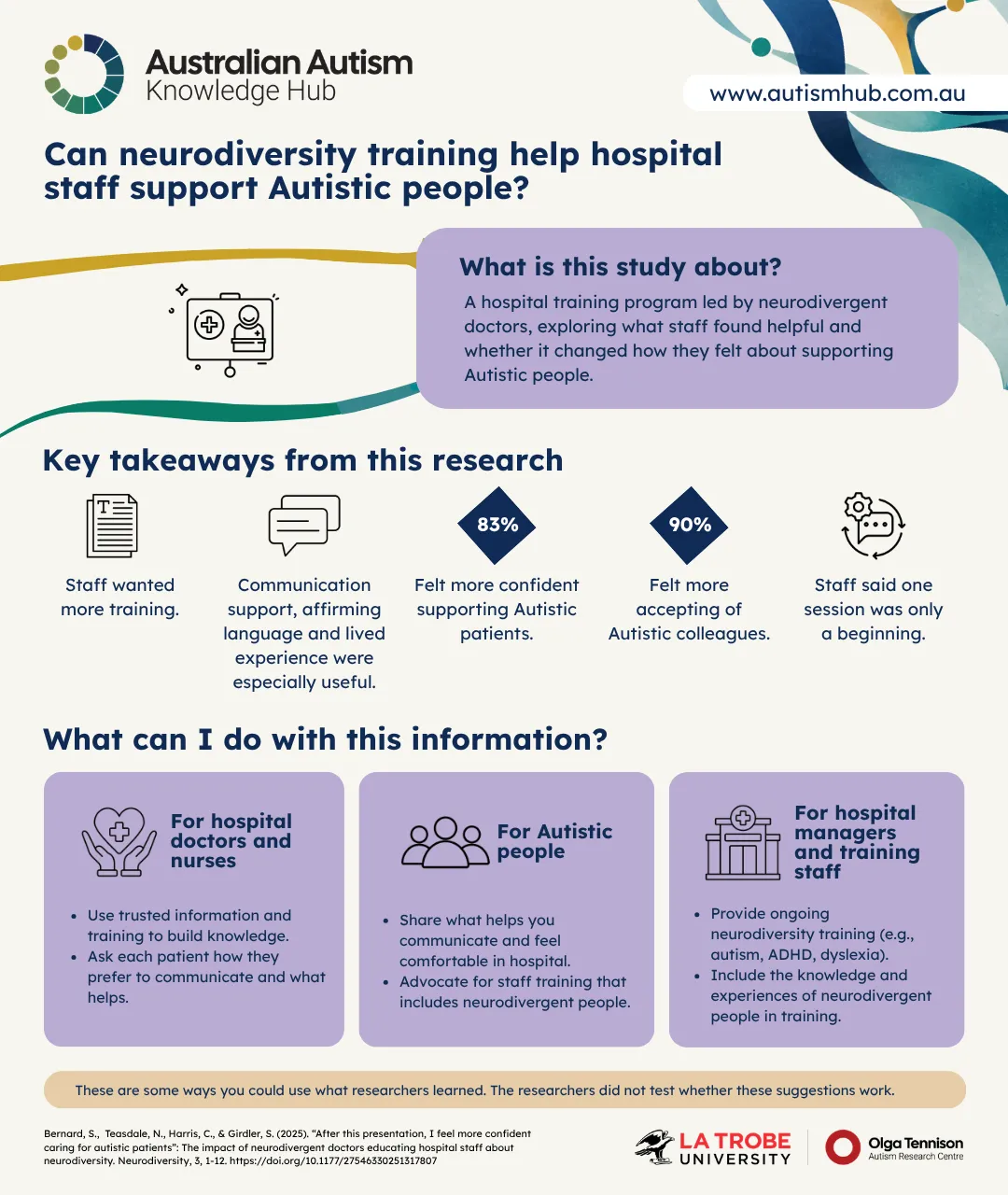
Staff wanted more training
- 72% of staff (21 out of 29) wanted more training about recognising differences between autism, ADHD, dementia, and mental health conditions.
- 62% (18 out of 29) wanted more information about changes that can help neurodivergent hospital staff do their jobs.
- 48% (14 out of 29) wanted more training about ADHD in healthcare settings, including emergency departments.
Some parts of the teaching were especially useful
- Five staff members said information about communication differences and ways to support communication was particularly useful. Four staff members said learning about neurodiversity terms and language was helpful.
- Some staff found an interactive activity about neurodivergent people’s experiences useful.
Staff reported feeling more confident caring for Autistic patients
- 83% of staff (24 out of 29) said they felt more confident caring for Autistic patients after the training.
- Staff said the training helped them notice their own assumptions and better understand things from Autistic people’s point of view.
- Some staff said learning about sensory differences, such as differences with processing sounds, helped them understand how Autistic people may be affected by the hospital environment.
Staff reported greater acceptance of Autistic colleagues
- 90% of staff (26 out of 29) said they felt more accepting of Autistic colleagues after the training.
- Some staff said that hearing neurodivergent doctors talk openly about their experiences helped challenge negative ideas.
What can I do with this information?
These are some ways you could use what the researchers learned. The researchers did not test whether these suggestions work.
For hospital doctors and nurses
- Use trusted information and training to learn about autism, communication differences and sensory needs. Do not rely on neurodivergent colleagues to teach you.
- Ask each patient how they prefer to communicate. For example, they may prefer written information, pictures, or extra time to answer questions. Check with each patient about what helps them feel comfortable and take part in their care. Do not assume all Autistic people need the same support.
- Ask whether noise, lighting, or other things in the hospital make the patient uncomfortable. Look for changes that could help, such as a quieter waiting area.
For hospital staff who plan or deliver training
- Invite neurodivergent people to help plan and deliver training. Pay them for their time and knowledge. Let them choose what they share and how they take part.
- Teach staff about communication differences, sensory needs, and ways to make hospital care more accessible. For example, show how staff could explain a procedure using clear language or written steps.
- When training staff, include activities that help them think about how their own beliefs may affect the way they treat Autistic patients and colleagues.
- Find out what staff want to know more about. Use their feedback to plan future training.
For Autistic people who use hospital services
- Tell staff how you prefer to communicate, if you feel comfortable doing so. For example, you could ask for information in writing or more time to answer questions.
- Ask whether changes can be made to help you feel more comfortable. This might include a quieter waiting area, different lighting, or having a support person with you.
- Ask staff to explain what will happen during an appointment, test, or procedure. You could also ask them to write down the steps.
- Ask someone you trust to help explain your needs or support you during appointments, if you would like this.
For carers of Autistic people who use hospital services
- Ask the person how they would like you to help during hospital visits. If they would like your help, tell staff what helps them communicate. For example, they may use pictures, gestures, a device, written words, or need extra time to answer.
- For someone with complex support needs, you could prepare short notes about how they communicate, what support they need, and how they may show pain, discomfort, or distress. Include what usually helps them feel safer or more comfortable.
- Ask staff to explain what will happen, one step at a time. You could ask them to write down the steps or explain them in a way the person understands.
- Ask what changes can be made during an appointment, test, or procedure. For example, you could ask for a quieter space, lower lighting, or breaks.
Questions to think about based on this study
If you work in a hospital
What do I know about neurodiversity, and what could help me notice and reduce my own assumptions about Autistic people?
If you develop hospital education
Does my training include the experiences and support needs of neurodivergent people?
If you are an Autistic person who uses hospital services
What would I want hospital staff to understand about being Autistic and using hospital services?
If you are a parent or carer of an Autistic person who uses hospital services
What would help me support the Autistic person I care for during a hospital visit, and what would I like staff to understand about their needs?
One thing to remember
Hospital staff said the education changed how confident and accepting they felt. The study did not show whether this led to better experiences or outcomes for Autistic patients.
Looking more closely at the study
Why and how was the study done?
The researchers identified a lack of training about autism and neurodiversity for staff in two hospital departments. They wanted to explore how education developed and delivered by neurodivergent doctors could help address this gap. They also wanted to understand what staff thought about the training, what they found useful, and what else they wanted to learn.
This was an intervention study. Researchers introduced a change. Then they measured what happened. The researchers gave hospital doctors and nurses neurodiversity training. After the training, they asked staff whether their knowledge, confidence, and attitudes towards neurodivergent people had changed.
Who was involved?
- 65 hospital staff took part in the training sessions. This included 53 doctors and 12 nurses. After the training, 29 people completed the survey. The findings are from these 29 surveys.
- Staff came from emergency and geriatric medicine departments in one Australian hospital. However, the study did not give much information about their backgrounds or personal characteristics, so we do not know how diverse the group was.
Who helped shape the research?
The training was led by two doctors who identified as neurodivergent. Hospital education leaders also gave input. The paper does not say whether Autistic patients or carers helped develop or review the training.
What questions are still unanswered?
- The training was viewed as useful and relevant. Would the training work in other hospitals, including hospitals in regional and rural areas?
- Staff reported feeling more confident and accepting after the training. Does the training lead to lasting changes in staff behaviour and better experiences for Autistic patients over a longer amount of time?
- Staff valued hearing personal experiences and said this changed their understanding of neurodiversity. Which parts of the training create the greatest benefit?
- Staff wanted to learn more about communication, sensory differences, changes that can help staff do their jobs, and the differences between autism, ADHD, dementia, and mental health conditions. What training do staff need to provide better support in real healthcare situations?
- The paper describes training at one hospital. It does not say whether other hospitals can use the training or how to get it. How can training like this become more available across Australia?
One study rarely changes practice.
When making decisions, it is important to consider this study alongside:
- People's values, needs, and lived experience
- Findings from other research studies
- Professional knowledge and expertise
All of these are important parts of an evidence-based approach.
Citation
Bernard, S., Teasdale, N., Harris, C., & Girdler, S. (2025). “After this presentation, I feel more confident caring for autistic patients”: The impact of neurodivergent doctors educating hospital staff about neurodiversity. Neurodiversity, 3, 1–12. https://doi.org/10.1177/27546330251317807
About this article
Choose a link to find similar articles
- Age/life stage:
- Adults
- Audience:
- Autistic adults, Families and carers, Health professionals
- Context:
- Health and support services
- Location:
- Australia