At a glance
Who may find this snapshot useful and why?
This snapshot may help Autistic people understand what can affect their experiences of employment and identify support they may want at work. It may help employers and employment services notice what makes work harder. It also explains how changes, ongoing support and good work relationships can help.
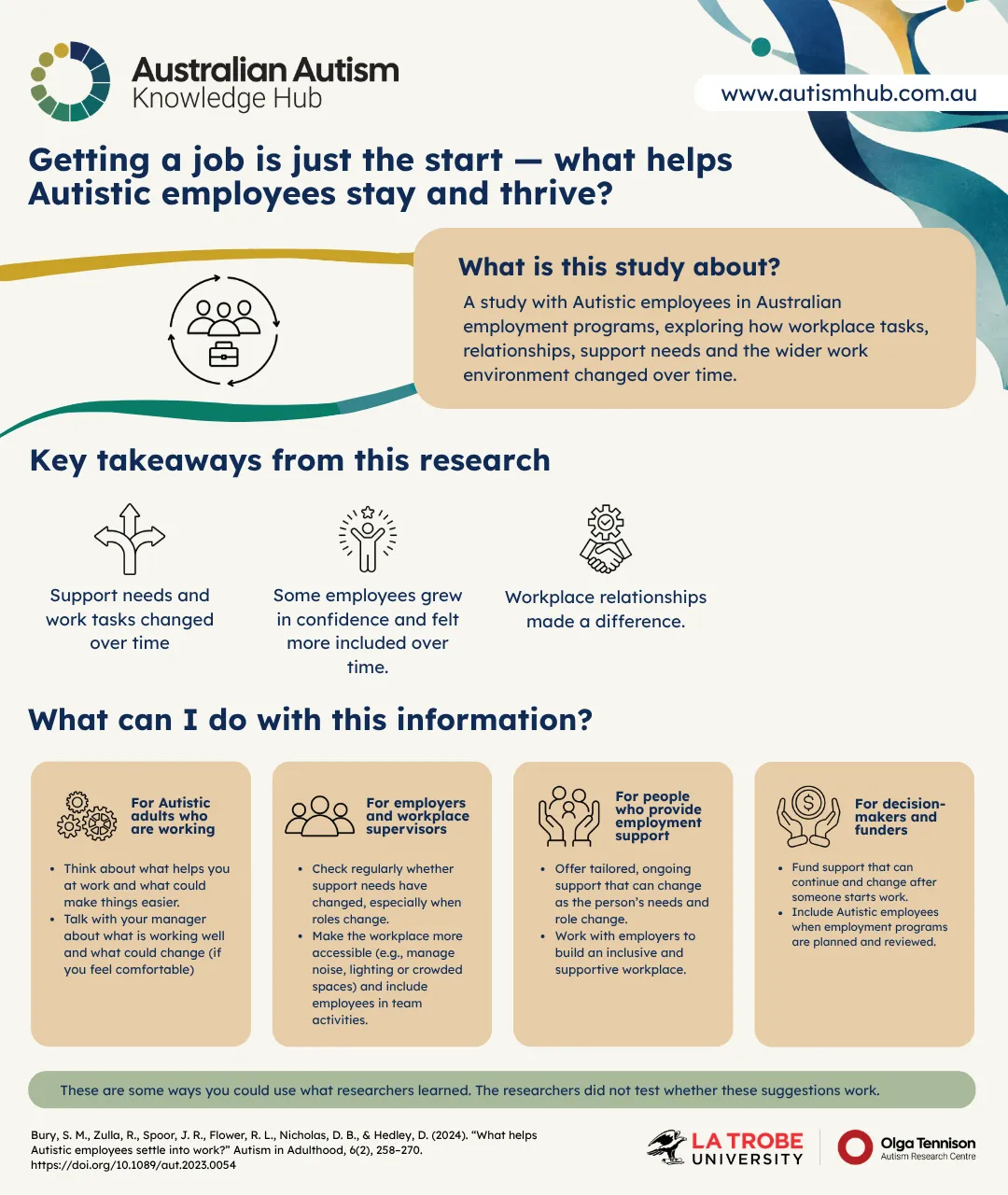
What is this study about?
Getting and keeping suitable work depends not only on an Autistic person’s skills, but also on what happens around them at work. This study asked Autistic employees in two Australian employment programs about their experiences. The researchers wanted to understand how workplace tasks, relationships, support, and the wider work environment changed over time.
Why did we choose to create a snapshot of this study?
Autistic people may already know that getting a job is only one part of having a positive experience at work. We thought this study was important to share because it looks at the different things that can affect Autistic people’s experiences at work. It encourages employers and employment services to think about the workplace, relationships and support available, rather than placing all the responsibility on Autistic employees.
What are the key takeaways from this research?
Support needs changed over time
- Employees described how their work tasks, workloads, and deadlines changed over time.
- Some found their tasks repetitive or too easy, while others found new tasks challenging.
- Managers supported employees by offering flexible hours, help with tasks, and help managing workloads.
Relationships mattered
- Supportive co-workers, including other Autistic employees, helped people manage work tasks and social situations.
- Employees valued having people they could ask for help, including managers, co-workers, and support staff.
- Being included in team meetings, conversations, and shared tasks helped some employees feel part of their workplace.
Some employees grew more confident and felt more included over time
- Some employees became more confident as they learned their jobs, gained experience, and developed relationships with co-workers.
- Feeling included and supported helped employees see themselves as valued members of their workplace.
- Some employees felt less included when they worked in separate areas, away from other teams.
What can I do with this information?
These are some ways you could use what the researchers learned. The researchers did not test whether these suggestions work.
For Autistic adults who are working
- Think about what helps you at work and whether anything could make your workday easier or more comfortable. This might include clear instructions, flexible hours, or changes to your workspace.
- If you feel comfortable, talk with your manager about what is working well and what could change.
- Ask for regular feedback about your work, including what is going well and whether anything needs to change.
- Review your support needs when your tasks, work hours, or workplace change.
For employers and workplace supervisors
- Check regularly whether employees need changes to their support, especially when their role changes.
- Make changes to the workplace to address things that may make it hard to work, such as noise, bright lights, uncomfortable temperatures, smells, or crowded spaces.
- Include employees in team meetings, shared tasks and workplace activities in ways that work for them.
- Make sure employees working in separate areas still have opportunities to connect with their teams.
- Provide clear, specific instructions and feedback about work tasks.
For people who provide employment support
- Offer training and guidance to managers and co-workers about different ways people communicate, work, and ask for help.
- Check in with employees and employers as tasks and work conditions change. Do not assume that the support needed when someone starts a job will always stay the same.
- Help employees build connections with managers and co-workers if they would like this, rather than relying only on one support worker.
Government decision makers and funders
- Provide funding for workplace support that can continue after an Autistic person starts a job. Make sure funding can be used for different types of support as an employee's role, workplace, or needs change.
- Fund training and guidance for managers, co-workers, and support staff, as well as support for Autistic employees.
- Include Autistic employees when planning and reviewing employment programs. Ask what is working and what needs to change.
Questions to think about based on this study
If you are an Autistic person working in a job
What support or workplace changes would help me do my job, manage challenges, and build confidence?
If you supervise an Autistic employee
How can I provide flexible work tasks, clear feedback, supportive relationships, and an accessible workplace?
If you provide employment support
How can you adjust support as an employee’s needs, skills and job tasks change?
If you are a Government decision maker or funder
How can funding support flexible, long-term employment programs and more accessible workplaces?
One thing to remember
Autistic employees have different support needs and preferences. These can change as their tasks, roles and workplace environments change.
Looking more closely at the study
Why and how was the study done?
The researchers wanted to better understand Autistic employees’ experiences in two Australian employment programs. Much of the research about autism and employment has focused on getting a job, rather than what happens after someone starts working. This study explored how workplace relationships, job tasks, support, and working conditions shaped employees' experiences over time.
This was an interview study. The researchers interviewed people about their experiences. People could describe their experiences in their own words.
Who was involved?
- The study included 33 Autistic employees: 29 men and 4 women. Their average age was 29 years.
- They came from two employment programs.
- About half worked part-time and the rest worked full-time.
Who helped shape the research?
- The article states that Autistic people were not involved in the design, data collection, analysis, or interpretation of the research.
- The research team included neurodivergent, non-Autistic researchers with experience in employment support and autism.
What are some questions that are still unanswered?
This study was relevant to the Australian context and provides useful practical information, but some questions are still unanswered:
- Employees’ tasks and support needs changed as their work and workplace changed. Which workplace changes are most useful at different stages of an Autistic person’s employment?
- Both programmes were in similar government workplaces. How do Autistic employees’ experiences compare across other types of work, such as retail, trades, hospitality or professional roles?
- The study focused on Autistic employees’ views. How do managers, co-workers, and support workers understand and shape employees’ workplace experiences?
- Most participants were men and generally well educated, and the study did not include Autistic employees with intellectual disability. Would the findings be similar for Autistic people with different genders, backgrounds, and support needs?
One study rarely changes practice.
When making decisions, it is important to consider this study alongside:
- People's values, needs, and lived experience
- Findings from other research studies
- Professional knowledge and expertise
All of these are important parts of an evidence-based approach.
Citation
Bury, S. M., Zulla, R., Spoor, J. R., Flower, R. L., Nicholas, D. B., & Hedley, D. (2024). An ecological systems model of employee experience in industry-led autism employment programmes. Autism, 28(6), 1457–1470. https://doi.org/10.1177/13623613241241574
About this article
Choose a link to find similar articles
- Topic:
- Work and employment
- Age/life stage:
- Adults
- Audience:
- Autistic adults, Policy makers
- Context:
- Community and social participation
- Location:
- Australia