At a glance
Who may find this snapshot useful and why?
This snapshot shares what people said about support at airports. It may help Autistic people and families think about what could make travel easier. It may also help airport staff understand what travellers need and how to make airports easier to use.
What is this study about?
Being able to travel helps people take part in family life, work, and holidays. But air travel can involve noise, crowds, changes in plans, and other unfamiliar experiences. This can make air travel difficult for some Autistic people. Sydney and Gold Coast airports introduced supports to make air travel easier and more accessible for Autistic people. The researchers wanted to find out if these supports were helpful to Autistic travellers and their families, and what else was needed.
Why did we choose to create a snapshot of this study?
Autistic people and their families may already know that airports can be stressful and difficult to move around. We are sharing this study because it describes what Autistic people and families thought about changes at Sydney and Gold Coast airports. It shows what helped and what still needs to change. This information may help airports make travel more accessible for Autistic people.
What are the key takeaways from this research?
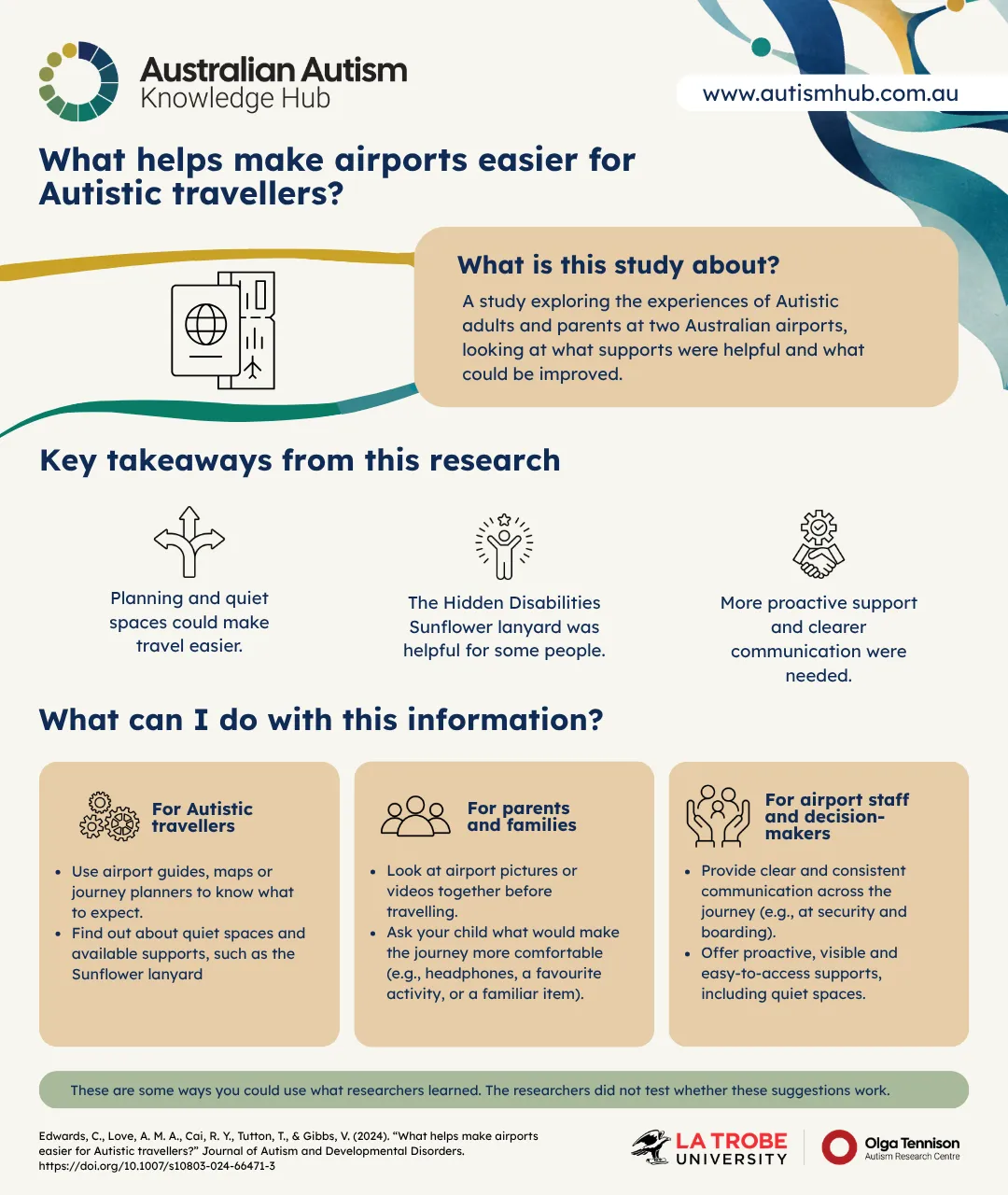
Planning and quiet spaces could make travel easier
- People described planning as important when getting ready for airport travel. Visual guides, journey planners, and sensory maps helped people know what would happen and feel prepared for their trip.
- Some travellers valued quiet spaces because they helped them cope with noise, crowds, and other sensory demands. They found it more accessible when these spaces were free, easy to find, and easy to use.
The Hidden Disabilities Sunflower lanyard was helpful for some people
- The Hidden Disabilities Sunflower lanyard is worn to let others know that someone may have a disability that is not immediately obvious.
- People described the lanyard as a useful way to signal that they may need understanding or support.
- Wearing the lanyard was helpful at security, but Autistic people wanted clearer signs at boarding so they knew they could use priority lanes and avoid crowds and stress.
More proactive support and clearer communication were needed
- People described ongoing sensory challenges even where supports were available. Some travellers still experienced difficulties with noise, crowds, and busy airport environments.
- They also wanted airport staff to provide clearer communication and support without making the traveller do all the asking.
What can I do with this information?
These are some ways you could use what the researchers learned. The researchers did not test whether these suggestions work.
For Autistic travellers
- Check the airport website for visual guides, journey planners, or maps. These can help you understand what to expect at check-in, security, and boarding.
- Find out whether the airport has quiet spaces, where they are, and how to use them.
- Consider whether you would like to use a Hidden Disabilities Sunflower lanyard or wristband. These let staff know you may need extra support or understanding without having to explain your disability. You can learn more about the program at the Hidden Disabilities Sunflower website.
- Contact the airport or airline to ask what support is available. For example, you could ask whether there is a quieter place to wait or a shorter security queue.
For parents and families travelling with Autistic children
- Look at airport pictures, videos, or journey planners with your child before travelling. Talk about what might happen during the trip.
- Ask your child what would make the journey more comfortable. For example, they may want to bring headphones, a favourite activity, or something familiar from home.
- Find quiet spaces on the airport map before travelling. Check whether they are free and easy to access.
- Ask your child whether they would like to use a Hidden Disabilities Sunflower lanyard or wristband and explain what it means. You can learn more about the program at the Hidden Disabilities Sunflower website.
- Contact the airport or airline to ask about support during security checks, waiting times, and boarding.
For airport and airline staff
- Ask travellers whether they would like help, rather than waiting for them to ask. Respect their choice if they do not want help.
- Make sure staff understand what the Hidden Disabilities Sunflower lanyard or wristband means and know what support they can offer.
- Explain what will happen next, especially during security checks, delays, or changes to boarding.
- Use clear signs and maps to show where quiet spaces are. Make sure staff know how travellers can access them.
- Clearly show where travellers can access assistance or priority boarding, where available. Explain who can use these options.
- Ask Autistic travellers and families whether the support was helpful and what could be changed. Use their feedback to improve services.
Questions to think about based on this study
If you are travelling as an Autistic person
What information, sensory adjustment, or form of assistance would make my next airport experience more predictable and manageable?
If you are travelling with an Autistic child
What can you find out before the trip to make the airport easier to manage?
If you work at an airport or airline
Would an Autistic traveller or family member know how to find support here, and would every staff member respond consistently and appropriately?
One thing to remember
Airport support can make travel easier, but people may still have different needs. The study found that planning, clear communication, and access to quieter spaces were important for some travellers.
Looking more closely at the study
Why and how was the study done?
Some airports have made changes to help Autistic travellers, but few studies have looked at whether these changes help. The researchers wanted to understand the experiences of Autistic adults and parents of Autistic children using Sydney and Gold Coast airports. They asked what helped, what was still difficult, and what airports could change.
This was an interview study. Researchers spoke with people to learn about their experiences, thoughts, and views in detail. People could describe their experiences in their own words. They could communicate in ways that worked for them (e.g., interview via email/text, phone, or video).
Who was involved?
- 13 people took part: 8 Autistic adults and 5 parents or carers of Autistic children who had travelled through Sydney or Gold Coast airports.
- The Autistic adults included people with a formal diagnosis and one self-identified Autistic adult.
- The group included people of different ages, genders, cultural backgrounds, and educational backgrounds. Most people who took part were women, White, and highly educated
Who helped shape the research?
An Autistic researcher led the study and used their own experiences of air travel to help shape the research. The research team also included a parent and sibling of an Autistic person, who both shared their perspectives.
What are some questions that are still unanswered?
The study provides useful practical findings, but the evidence base remains limited.
- The study was conducted in two Australian airports where supports had been introduced. Would the same supports work equally well at other Australian airports?
- The 13 people in the study talked about how useful they found the supports. Which changes to airports would make the biggest difference to Autistic people’s travel experiences?
- Autistic adults and parents talked about their experiences. How do Autistic children themselves experience these things?
- Some people wanted airport staff to offer support instead of making them ask for it. What changes would best support people who need help without having to ask?
One study rarely changes practice.
When making decisions, it is important to consider this study alongside:
- People's values, needs, and lived experience
- Findings from other research studies
- Professional knowledge and expertise
All of these are important parts of an evidence-based approach.
Citation
Edwards, C., Love, A. M. A., Cai, R. Y., Tutton, T., & Gibbs, V. (2024). Exploring autism-friendly initiatives in Australian airports: “A lot better than a lot of airports that I’ve experienced”. Current Issues in Tourism, 1–17. https://doi.org/10.1080/13683500.2024.2422049
About this article
Choose a link to find similar articles
- Topic:
- Sensory experiences and environments, Autism and Autistic experiences, Daily life, housing and rights
- Age/life stage:
- Across the lifespan
- Audience:
- Autistic adults, Families and carers, Service providers
- Priority cohort:
- Children and young people
- Context:
- Community and social participation
- Location:
- Australia, International