At a glance
Who may find this snapshot useful and why?
This snapshot may help Autistic people explain what they need and ask services for changes. It may also help mental health clinicians understand the barriers people reported and consider how to make care easier to access and better suited to each person.
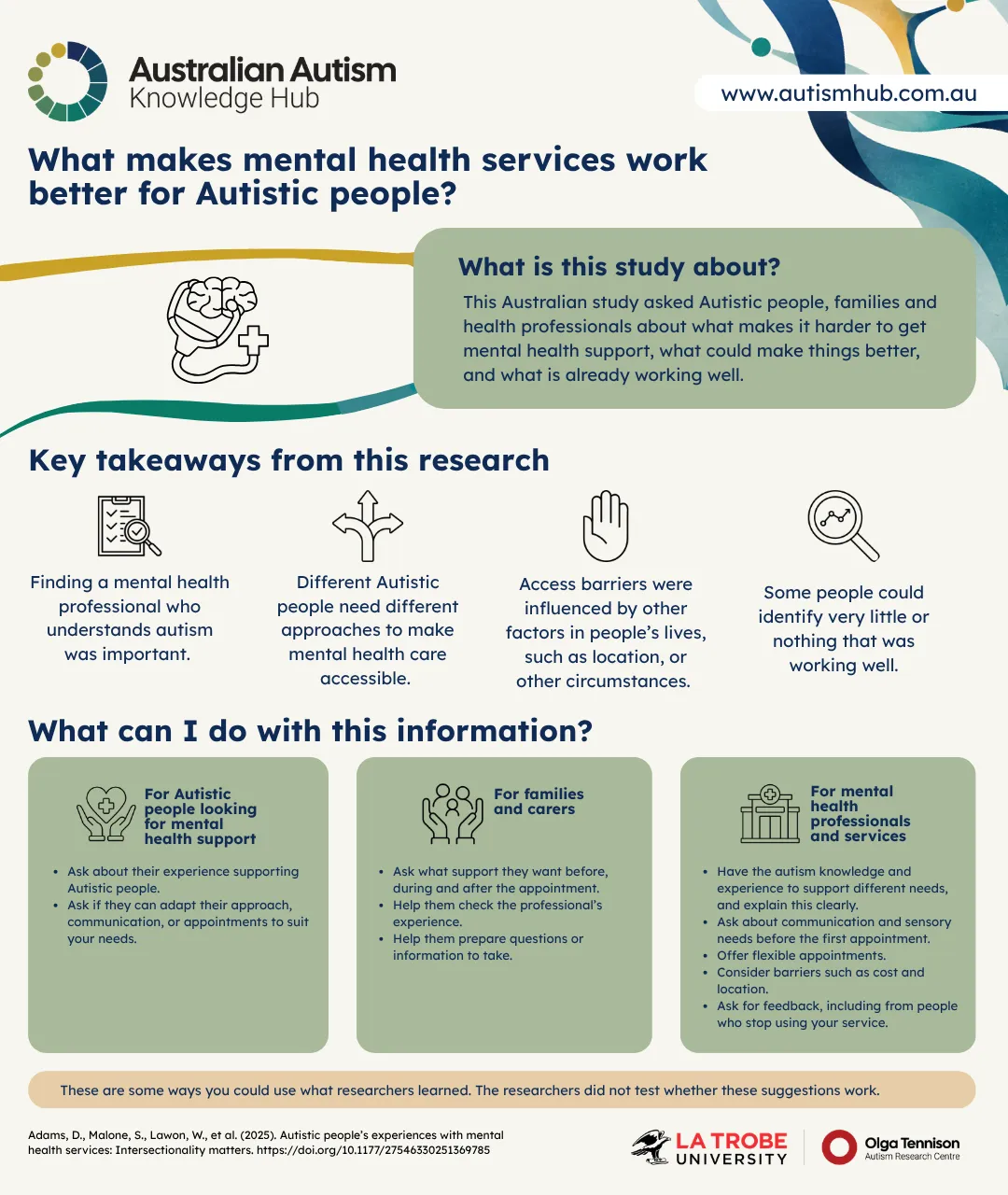
What is this study about?
Autistic people can face barriers when trying to get mental health support. This Australian study asked Autistic people, families, and health professionals about what makes access harder, what could make things better, and what is already working well. It also looked at whether experiences differ for groups of people, such as women, LGBTQIA+ people, older people, people on low incomes, and people living in regional or remote areas.
Why did we choose to create a snapshot of this study?
Autistic people and families may already be aware of the difficulties described in this study. We felt the findings of this study were important to share as the study brings many people’s experiences together to show how common the problems are. It also shows that people with different roles (e.g. Autistic people, family, providers) recognise the same problems.
What are the key takeaways from this research?
Finding a mental health professional who understands autism was important
- One in four people said that finding skilled professionals who understand autism was a problem. People also said that mental health services are more helpful when the professional understands autism.
- This shows that finding suitable mental health care for Autistic people involves more than just finding a professional with an appointment. Autistic people also need to find a professional who understands autism enough to support their mental health needs.
Different Autistic people need different approaches to make mental health care accessible
- People said that mental health services could be more helpful if they changed how they worked to meet each person's needs.
- No single approach works for everyone. This shows why services need to ask Autistic people what works for them, rather than assuming everyone needs the same support.
Access barriers were influenced by other factors in people’s lives
- People’s life experiences influenced the problems they reported when looking for mental health support.
- For example, more Autistic people with lower incomes said they find it hard to find a mental health professional who has available appointments. More older Autistic people said it was hard to find a professional who understood autism and how it presents across the lifespan.
Some people could identify very little or nothing that was working well
- Many people reported that little or nothing was working well in mental health services.
- Some people said that support from family, friends, and the Autistic or neurodivergent community was helpful in supporting their mental health.
What can I do with this information?
These are some ways you could use what the researchers learned. The researchers did not test whether these suggestions work.
For Autistic people looking for mental health support
When looking for a mental health professional, you could ask:
- What experience do you have working with Autistic people?
- How do you change your approach to meet different people's needs?
- Can I communicate in different ways, such as writing things down instead of speaking?
- Can appointments be changed to suit my needs, such as the time, length, or location?
You can also tell the service what has or hasn't worked for you in the past, if you feel comfortable doing so.
These questions do not guarantee appropriate care, but they can help you to decide on whether the professional is right for you.
For families and carers
If you are helping an Autistic person find mental health support, you could:
- Ask them what support they would like from you before, during, or after the appointment.
- Help them find out whether a professional has experience working with Autistic people – the questions above may be helpful for you when contacting services.
- Help them prepare questions or information they want to share before an appointment. This may include creating a checklist of items to take on the day, like sensory tools, previous reports, or drinks/snacks available in their bag.
For mental health professionals and services
- Make sure staff have enough knowledge and experience to support Autistic people of different ages and backgrounds. Make it clear what experience staff have working with Autistic people. For example, you could include this information on your website.
- Before an initial appointment, ask people how they prefer to communicate and whether they have any sensory preferences. Ensure this information is used to shape any engagement.
- Consider whether appointment times, length, location, or ways of attending can be changed to meet individual needs.
- Consider how cost, location, and other circumstances might make it harder for some Autistic people to access your service.
- Ask Autistic people what is and isn't working well in your service and use this feedback to make improvements. Asking for feedback from people who have stopped using your service may give you additional information to help improve accessibility of your service.
Questions to think about based on this study
If you are an Autistic person looking for mental health support
- What helps me feel safe, understood, and able to communicate?
- How can I explain these needs to the service?
If you support someone who is looking for care
- How can I help the service understand the Autistic person’s preferences, strengths, experiences and support needs?
- Are there barriers that the service could address, rather than expecting the Autistic person or their family to manage them?
If you provide mental health care
- How do you know whether your service is working well for Autistic people, including those with different needs and backgrounds?
- Could your service be easier to access for some groups of Autistic people than others? What might need to change?
- How might you recognise when your usual approach isn't working for an Autistic person?
One thing to remember
Finding mental health support that feels right can be difficult. The study highlights that people have different needs and experiences, so support needs to be flexible. One service or approach will not work for everyone.
Looking more closely at the study
Why and how was the study done?
Autistic people can face difficulties getting mental health support that meets their needs. The researchers wanted to understand these difficulties from the views of Autistic people, families, and professionals. They also wanted to find out what was working well, what could be improved, and whether Autistic people from different backgrounds or life circumstances reported different experiences.
This was an online survey. Researchers asked people the same set of questions. People could describe problems, possible solutions, and what was working well in their own words. The researchers grouped similar answers and compared what different groups said.
Who was involved?
- 539 people in Australia were involved. This included 250 Autistic people. The people had different genders, ages, locations and financial situations. Some also identified as LGBTQIA+.
- There were also family members, carers, and mental health, medical or allied health professionals.
- Some people who answered the questions were part of more than one group (e.g., Autistic person and professional).
Who helped shape the research?
- Autistic people helped shape and improve the survey, and the way that results were reported.
- The research team included Autistic and otherwise neurodivergent researchers. The team included people with different genders, ages, ethnic backgrounds, sexualities, financial situations and experiences with mental health services.
What are some questions that are still unanswered?
The study provides useful practical findings, but the evidence base remains limited.
- The researchers found some differences between groups of Autistic respondents, but they did not explore why these differences occurred or how different parts of a person’s identity may combine. How do these factors shape people’s experiences?
- Few people in the study had high or complex support needs, so we still need to learn more about what support works for them. How can mental health services better support Autistic people who were not included in large numbers in this study?
- The study asked Autistic people about their experiences but did not test whether changes to services would improve their mental health or care. What changes could improve mental health services for Autistic people?
- The study did not test whether service changes would work in different locations. Would these changes work across different mental health services and communities in Australia?
One study rarely changes practice.
When making decisions, it is important to consider this study alongside:
- People's values, needs, and lived experience
- Findings from other research studies
- Professional knowledge and expertise
All of these are important parts of an evidence-based approach.
Citation
Adams, D., Malone, S., Lawson, W., Breasley, J., Girdler, S., & Carroll, A. (2025). Autistic people’s experiences with mental health services: Intersectionality matters. Neurodiversity, 3, 1–27. https://doi.org/10.1177/27546330251369785
About this article
Choose a link to find similar articles
- Topic:
- Mental health and wellbeing
- Age/life stage:
- Adults, Older adults
- Audience:
- Autistic adults, Families and carers, Health professionals
- Priority cohort:
- LGBTQIA+ people, Older people, Women and girls
- Context:
- Health and support services
- Location:
- Australia